 https://www.linkedin.com/pub/mark-jensen/8/a28/ab0
Mark S. Jensen, Ph.D., Research Investigator and
Group Leader in the Process Research Department at SCYNEXIS. Dr. Jensen
worked for Merck in the process research department before moving to
SCYNEXIS, where he continues to design and develop novel and efficient
routes to early and late stage drug candidates. These processes are used
at SCYNEXIS for the production of API for clinical programs. Mark holds
a Ph.D. from Oregon State University and was an NIH Postdoctoral Fellow
at the University of California, Irvine
https://www.linkedin.com/pub/mark-jensen/8/a28/ab0
Mark S. Jensen, Ph.D., Research Investigator and
Group Leader in the Process Research Department at SCYNEXIS. Dr. Jensen
worked for Merck in the process research department before moving to
SCYNEXIS, where he continues to design and develop novel and efficient
routes to early and late stage drug candidates. These processes are used
at SCYNEXIS for the production of API for clinical programs. Mark holds
a Ph.D. from Oregon State University and was an NIH Postdoctoral Fellow
at the University of California, Irvine.
Experience
Education
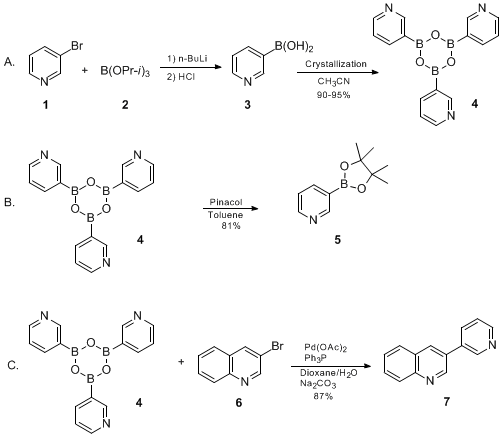
An Improved Protocol for the Preparation of 3-Pyridyl- and Some Arylboronic Acids
Process
Research Department, Merck Research Laboratories, P.O. Box 2000,
Rahway, New Jersey 07065 wenjie_li@merck.com; dorian_nelson@merck.com
J. Org. Chem., 2002, 67 (15), pp 5394–5397
DOI: 10.1021/jo025792p
Publication Date (Web): June 13, 2002
Copyright © 2002 American Chemical Society
Abstract
3-Pyridylboronic
acid was prepared in high yield and bulk quantity from 3-bromopyridine
via a protocol of lithium−halogen exchange and “in situ quench”. This
technique was further studied and evaluated on other aryl halides in the
preparation of arylboronic acids.
paper
.

4
compd4=
The checkers obtained
trispyridylboroxin in various hydration levels (0.85 - 1.0 H
2O). A satisfactory melting point for this solid could not be obtained.
1H NMR
pdf (400 MHz, CD
3OD): δ 7.66 (br s, 1H), 8.38 (d, J=6.6, 1H), 8.51 (dd, J=1.2, 4.4, 1H), 8.61 (br s, 1 H).
1H NMR spectra were complicated in other solvents such as CDCl
3 and DMSO-d
6. Anal Calcd. for C
15H
12B
3O
3N
3 · 1.0H
2O: C, 54.15; H, 4.24; N, 12.63. Found: C, 53.95; H, 3.91; N, 12.35. Yield based on this formula is
85%. The submitters report obtaining the product in
91% yield.

7
compd7=
The following characterization data was obtained:
mp: 122-125°C; IR (KBr pellet): cm
−1 3044, 1568, 1495, 1410, 1338, 1298, 1187, 1126, 1059, 1022, 952, 932, 816, 784, 758, 709, 909, 808, 786, 752, 709, 61;
1H NMR
pdf (500 MHz, CDCl
3):
δ 7.45 (ddd, J=0.9, 4.9, 7.9, 1H), 7.60 (dt, J=0.9, 7.9, 1H), 7.75
(ddd, J=1.2, 6.8, 8.3, 1H), 7.90 (dd, J=0.9, 8.1, 1H), 8.00 (dt, J=2.2,
7.8, 1H), 8.15 (d, J=8.4, 1H), 8.32 (d, J=2.3, 1H), 8.68 (dd, J=1.5,
4.9, 1H), 8.97 (d, J=2.1, 1H), 9.15 (d, J=2.1, 1H);
13C NMR (126 MHz, CDCl
3)
δ 123.8, 127.3, 127.8, 128.0, 129.3, 129.9, 130.6, 133.57, 133.63,
134.6, 147.7, 148.5, 149.27, 149.29; MS (EI, 70 eV): 207 (16), 206 (M+,
100), 205 (40); HRMS (EI) m/z 206.0847, calcd for C
14H
10N
2 206.0944. Anal. Calcd for C
14H
10N
2: C, 81.53; H, 4.89; N, 13.58. Found: C, 81.43; H, 4.86; N, 13.40.

5
compd5= The checkers obtained the product in
74-82% yield in different runs. The product exhibits the following physical properties:
mp 102-105°C; IR (KBr pellet) cm
−1 2994, 2968, 2932, 1609, 1572, 1476, 1410, 1361, 1209, 1154, 1063, 1017, 953, 926, 859, 833, 800, 759, 705;
1H NMR
pdf (500 MHz, CDCl
3): δ 1.33 (s, 12H), 7.25 (ddd, J=1.1, 4.9, 7.5, 1H), 8.03 (dt, J=1.8, 7.5, 1H), 8.64 (dd, J=1.9, 4.9, 1H), 8.93 (d, J=1.1, 1H);
13C NMR (126 MHz, CDCl
3)
δ 24.8, 84.1, 123.0, 142.2, 152.0, 155.5; MS (EI, 70 eV): 205 (M+, 46),
204 (15), 191 (12), 190 (100), 189 (25), 162 (10), 148 (44), 147 (14),
120 (18), 119 (11), 106 (100), 105 (35), 85 (15), 59 (17), 58 (19); HRMS
(EI) m/z 205.1280, calcd for C
11H
16NO
2B 205.1274. Anal. Calcd for : C
11H
16BO
2N: C, 64.43; H, 7.86; N, 6.83. Found: C, 64.23; H, 7.99; N, 6.88.
/////////
 phd scholarships in singapore


 DRUG APPROVALS BY DR ANTHONY MELVIN CRASTO .....FOR BLOG HOME CLICK HERE


 Googleplus
 amcrasto@gmail.com
 .
.


