DR ANTHONY MELVIN CRASTO,WorldDrugTracker, helping millions, A 90 % paralysed man in action for you, I am suffering from transverse mylitis and bound to a wheel chair,With death on the horizon, This will not stop me, Gods call only..........
DR ANTHONY MELVIN CRASTO Ph.D ( ICT, Mumbai) , INDIA 29Yrs Exp. in the feld of Organic Chemistry,Working for GLENMARK PHARMA at Navi Mumbai, INDIA. Serving chemists around the world. Helping them with websites on Chemistry.Million hits on google, world acclamation from industry, academia, drug authorities for websites, blogs and educational contributio
n
Showing posts with label germany. Show all posts

Wednesday, 10 June 2015

Flow Synthesis of Fluorinated α-Amino Acids

thumbnail image: Flow Synthesis of Fluorinated α-Amino Acids

Dr. Susan Wilkinson, Deputy Editor for the European Journal of Organic Chemistry, talks to Professor Beate Koksch, Freie Universität Berlin, Germany, and Professor Peter Seeberger, Max Planck Institute of Colloids and Interfaces, Potsdam, Germany, about their article on the synthesis of fluorinated amino acids recently published in the European Journal of Organic Chemistry.

Flow Synthesis of Fluorinated α-Amino Acids

Dr. Wilkinson, European Journal of Organic Chemistry, talks to Professors Koksch and Seeberger about fluorinated amino acids
Read more
http://www.chemistryviews.org/details/ezine/7956531/Flow_Synthesis_of_Fluorinated_-Amino_Acids.html
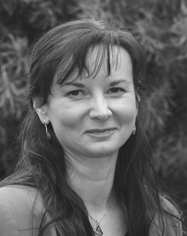
 Professor Beate Koksch, Freie Universität Berlin, Germany,
.Prof. Dr. Beate Koksch
Institute of Chemistry and Biochemistry – Organic Chemistry 
Freie Universität Berlin 
Takustr. 3
14195 Berlin
Working Group: AG Koksch
Space: 32.18
Tel .: + 49-30-838-55344, Fax -55 644
Secretariat:
Tel .: + 49-30-838-55880
(woman Skowronski, room 32.17)
Email: Beate.Koksch (At)fu-berlin.de

.
Koksch ++49 – 30 – 838 55344
 e-mail
 homepage (http://userpage.chemie.fu-berlin.de/~akkoksch/)
Free University of Berlin
Takustr. 3
14195 Berlin
Germany

Nominated by

  • German Research Foundation (DFG)
  • AcademiaNet member since 13.03.2015

Employed by

  • Freie Universität Berlin

Academic Discipline/Fields

  • Natural sciences/ Engineering/ Agricultural sciences

Field

Chemistry

Area of specialisation

Organic and Natural Product Chemistry

Research interests

  • folding mechanisms occuring in neurodegenerative diseases
  • developing new multivalent scaffolds
  • investigating the impact of fluorine on amino acids, peptides and proteins

Distinctions and Awards

  • Georg Thieme publisher’s award, 2002Lessing medal in gold, 1986
………………………………………………..
Professor Peter Seeberger, Max Planck Institute of Colloids and Interfaces, Potsdam, Germany

Since 2011, Professor Peter H. Seeberger, Max Planck Institute of Colloids and Interfaces in Potsdam, Germany, is Editor-in-Chief of the Beilstein Journal of Organic Chemistry.
Editor-in-Chief of the Beilstein Journal of Organic Chemistry is Professor Peter H. Seeberger, Max Planck Institute of Colloids and Interfaces in Potsdam, Germany, who is supported by a distinguished board of associate editors, each of whom is responsible for a particular subject area within the journal’s scope. Over 40 scientists from all over the world, including several Nobel Prize laureates, support the Beilstein Journal of Organic Chemistry as Advisory Board members.
Prof. Dr. Peter H. Seeberger
Director
Phone:+49 30 838-59301Fax:+49 30 838-59302
Email:boehme@…

German researchers develop cheap and high-yield process to manufacture anti-malaria drug

Jan 18, 2012
Researchers at the Max Planck Institute of Colloids and Interfaces in Potsdam and the Freie Universität Berlin have developed a very simple process for the synthesis of artemisinin – the best anti-malaria drug – more economically and in sufficient volumes for all patients. This means that it will be possible to provide medication for the 225 million malaria patients in developing countries at an affordable price.
An Anopheles female mosquito that transmits malariaAn Anopheles female mosquito that transmits malaria(© picture alliance/dpa Fotografia)Over one million people die of malaria each year because they do not have access to effective drugs.Millions, especially in the developing world, cannot afford the combination drug preparation, which consists mainly of artemisinin.
Moreover, the price for the medication varies, as this substance is isolated from sweet wormwood (Artemisia annua) which grows mainly in China and Vietnam, and varies seasonally in its availability.
Pharmaceutical companies could only obtain the drug from plants up to now. The chemists use a waste product from current artemisinin production as their starting substance. This substance can also be produced biotechnologically in yeast, which the scientists convert into the active ingredient using a simple yet very ingenious method.
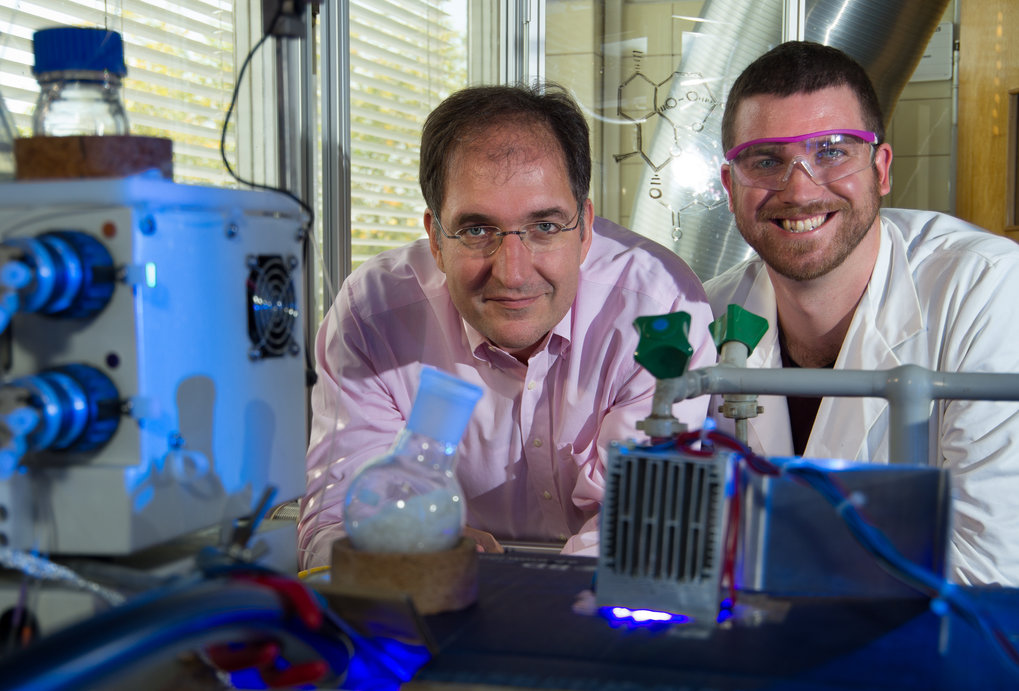
This may be about to change. Peter H. Seeberger, Director at the Max Planck Institute of Colloids and Interfaces in Potsdam and Professor of Chemistry at the Freie Universität Berlin and his colleague François Lévesque have discovered a very simple way of synthesising the artemisinin molecule, which is known as an anti-malaria drug from traditional Chinese medicine and has an extremely complex chemical structure. “The production of the drug is therefore no longer dependent on obtaining the active ingredient from plants,” says Peter Seeberger.
Synthesis from a by-product of artemisinin production
As a starting point, the chemists use artemisinic acid – a substance produced as a hitherto unused by-product from the isolation of artemisinin from sweet wormwood, which is produced in volumes ten times greater than the active ingredient itself. Moreover, artemisinic acid can easily be produced in genetically modified yeast as it has a much simpler structure. “We convert the artemisinic acid into artemisinin in a single step,” says Peter Seeberger. “And we have developed a simple apparatus for this process, which enables the production of large volumes of the substance under very controlled conditions.”
The effect of the molecule, which not only targets malaria but possibly also other infections and even breast cancer, is due to, among other things, a very reactive chemical group formed by two neighbouring oxygen atoms – which chemists refer to as an endoperoxide. Peter Seeberger and François Lévesque use photochemistry to incorporate this structural element into the artemisinic acid. Ultraviolet light converts oxygen into a form that can react with molecules to form peroxides.
800 photoreactors should suffice to cover the global requirement for artemisinin
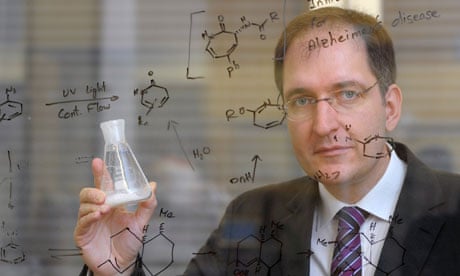
Dr. Peter H. Seeberger, Director at the Max Planck Institute of Colloids and Interfaces in Potsdam and Professor of Chemistry at the Freie Universität BerlinDr. Peter H. Seeberger, Director at the Max Planck Institute of Colloids and Interfaces in Potsdam and Professor of Chemistry at the Freie Universität Berlin(© dpa)“Photochemistry is a simple and cost-effective method. However, the pharmaceutical industry has not used it to date because it was so difficult to control and implement on a large scale,” explains Peter Seeberger.
“The fact that we do not carry out the synthesis as a one-pot reaction in a single vessel, but in a continuous-flow reactor enables us to define the reaction conditions down to the last detail,” explains Peter Seeberger.
After just four and a half minutes a solution flows out of the tube, in which 40 percent of the artemisinic acid has become artemisinin. “We assume that 800 of our simple photoreactors would suffice to cover the global requirement for artemisinin,” says Peter Seeberger. And it could all happen very quickly. Peter Seeberger estimates that the innovative synthesis process could be ready for technical use in a matter of six months. This would alleviate the global shortage of artemisinin and exert considerable downward pressure on the price of the associated drugs…….see        http://www.india.diplo.de/Vertretung/indien/en/__pr/Edu__Science__News/Malaria__drug.html

Max Planck Institute for Colloids and Interfaces

Peter Seeberger2

Peter Seeberger
Department of Biomolecular Systems
Max Plank Institute for Colloids and Interfaces
(Potsdam, Germany)
peter.seeberger@mpikg.mpg.de
http://www.peter-seeberger.de/
The core interests our research program currently address the following areas:
Automated oligosaccharide synthesis
  • Rapid access to monosaccharide by de-novo synthesis
  • New protecting groups
  • New Glycosylating Agents
  • New linkers for solid phase carbohydrate synthesis
  • Assembly of complex structures (in particular N-Glycans, O-Glycans)
  • Optimization of steps followingthe assembly, like deprotection, modification and conjugation
Total Synthesis of Biologically Important Oligosaccharides
  • Tumor-associated antigens
  • HIV-related oligosaccharides
  • Bacterial cell-surface antigens
  • N-linked glycoproteins
Chemical Synthesis and Biochemistry of Proteoglycans
  • Modular synthesis of heparin/heparan sulfates
  • Creation of heparin microarray
  • Optimization of the building blocks synthesis
  • Study of the SAR (structure-activity relationship) and the interactions between Proteoglycans and proteins
  • Automated synthesis of heparin fragments
Total Synthesis and Biological Activity of Glycosylphosphatidylinositols (GPIs)
  • Total syntheses of GPIs
  • Development of a synthetic GPI malarial vaccine
  • Elucidation of the biosynthesis of GPI
  • Immunological response to synthetic GPIs
Development of Cabohydrate-based Vaccines
  • A fully synthetic malaria vaccine
  • Leishmania vaccine
  • Synthetic HIV vaccine
  • Synthetic TB vaccine
Microreactors for Organic Synthesis
  • (Automated) Synthesis in continuous flow Microreactors
  • Photochemistry in Microflow reactors
  • Catalysis in Microreactors
Carbohydrate Microarrays
De novo synthesis
Nanoparticules and Colloidal Polymers
  • Quantum dots
  • Supramolecular dendrimers
  • Emulsion polymerization of nanoparticules


http://www.theguardian.com/technology/2012/feb/05/malaria-drug-synthesis-peter-seeberger
.
take a tour
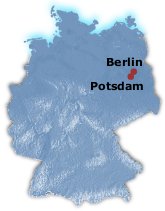
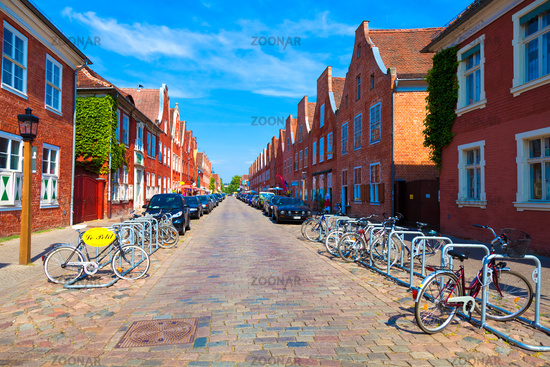
Potsdam, Germany
  1. Potsdam – Wikipedia, the free encyclopedia

    en.wikipedia.org/wiki/Potsdam
    Potsdam (German pronunciation: [ˈpɔtsdam] ( listen)), is the capital city of the German federal state of Brandenburg. It directly borders the German capital Berlin  …
Map of potsdam germany


  DRUG APPROVALS BY DR ANTHONY MELVIN CRASTO .....FOR BLOG HOME CLICK HERE


Join me on Linkedin

View Anthony Melvin Crasto Ph.D's profile on LinkedIn

Join me on Facebook FACEBOOK
Join me on twitterFollow amcrasto on Twitter     
Join me on google plus Googleplus

 amcrasto@gmail.com


//////////////

Sunday, 25 January 2015

Prof. Dr. Axel Jacobi von Wangelin


Prof. Dr. Axel Jacobi von Wangelin
  1. FACULTY OF CHEMISTRY AND PHARMACY
  2. Institute of Organic Chemistry

Research Group , Axel Jacobi von Wangelin

Building CH, 13.1.82
Phone +49 (0)941 943-4802
Fax +49 (0)941 943-4617
E-mail: axel.jacobi@ur.de
Professor of Organic Chemistry (2011), 
Heisenberg Group Leader (Cologne, 2011) 
Emmy Noether Group Leader (Cologne, 2005-2010), 
DAAD Postdoc (Stanford, B. M. Trost, 2003-2004), 
Postdoc (Cardiff, K. J. Cavell, 2003), 
Visiting Scientist (Degussa, 2002-2003), 
Ph.D. (Rostock, M. Beller, 2002), 
Visiting Scholar (Utah, J. A. Gladysz, 1999), 
M.Sc. (Erlangen, J. A. Gladysz, 1998), B.Sc. (Erlangen, 1994)
Awards: ORCHEM Award of the Liebig Association (2012), Heisenberg Fellow of the DFG (2011), Science Award of the Industrieclub (2009), Thieme Journal Award (2007), Emmy Noether Fellow of the DFG (2005-2010), DAAD Fellow (2003-2004), Joachim Jungius Dissertation Award (2002)
Most cited publications:
1. Coming of Age: Sustainable Iron-Catalyzed Cross-Coupling Reactions
Times Cited: 285 (Web of Science Core Collection®)
2. Multicomponent coupling reactions for organic synthesis: Chemoselective reactions with amide-aldehyde mixtures
Times Cited: 173 (Web of Science Core Collection®)
3. Dinuclear Zn-catalyzed asymmetric alkynylation of unsaturated aldehydes
Times Cited: 155 (Web of Science Core Collection®)

more................
http://www.researcherid.com/ProfileView.action?returnCode=ROUTER.Unauthorized&queryString=KG0UuZjN5WlnUgQXxhsj4VTS5Hx4sF8eU%252BJqDvjTrPk%253D&SrcApp=CR&Init=Yes


Postal address
Prof. Dr. Axel Jacobi von Wangelin
Institut für Organische Chemie
Universität Regensburg
Universitätsstraße 31
D-93053 Regensburg
Germany
Tel.: +49 (0)941 943-4802   (+49 (0)221 470-6122)
Fax: +49 (0)941 943-4617
e-mail: axel.jacobi@chemie.uni-regensburg.de 


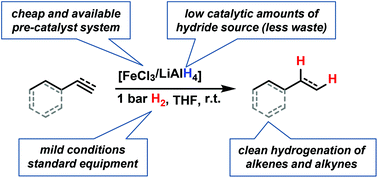
Iron-catalyzed olefin hydrogenation at 1 bar H2 with a FeCl3–LiAlH4catalyst


The scope and mechanism of a practical protocol for the iron-catalyzed hydrogenation of alkenes and alkynes at 1 bar H2 pressure were studied. The catalyst is formed from cheap chemicals (5 mol% FeCl3–LiAlH4, THF). A homogeneous mechanism operates at early stages of the reaction while active nanoparticles form upon ageing of the catalyst solution.

Iron-catalyzed olefin hydrogenation at 1 bar H2 with a FeCl3–LiAlH4catalyst

*Corresponding authors
aInstitute of Organic Chemistry, University of Regensburg, 93040 Regensburg, Germany
bInstitute of Inorganic Chemistry, University of Regensburg, 93040 Regensburg, Germany
Green Chem., 2015, Advance Article
DOI: 10.1039/C4GC02368D
regensburg........


University of Regensburg
Regensburg Wurstkueche. Wurstküche


Restaurant “Historisches Wurstkuchl” in Regensburg


Journals 
H. Neumann, A. Jacobi von Wangelin, D. Gördes, A. Spannenberg, M. Beller, A New Multicomponent Coupling of Aldehydes, Amides, and Dienophiles: Atom-Efficient One-Pot Synthesis of Highly Substituted Cyclohexenes and Cyclohexadienes, J. Am. Chem. Soc. 2001123, 8398.
A. Jacobi von Wangelin, H. Neumann, D. Gördes, A. Spannenberg, M. Beller, A Facile Three-Component Coupling Procedure for the Synthesis of Substituted Tetrahydroisoindole-1,3-diones from α,β-Unsaturated Aldehydes, Org. Lett. 20013, 2895. 
H. Neumann, A. Jacobi von Wangelin, D. Gördes, A. Spannenberg, W. Baumann, M. Beller, Multicomponent Coupling Reactions of Aldehydes and Amides with Maleic Anhydride: Synthesis of 7-Oxo-6-azabicyclo[3.2.1]oct-2-ene-8-carboxylic Acid Derivatives, Tetrahedron 200258, 2381. 
D. Gördes, H. Neumann, A. Jacobi von Wangelin, C. Fischer, K. Drauz, H.-P. Krimmer, M. Beller, Synthesis of N-Acetyl α-Aminobutyric Acid via Amidocarbonylation: A Case Study, Adv. Synth. Catal2003345, 510. 
A. Jacobi von Wangelin, H. Neumann, D. Gördes, S. Klaus, H. Jiao, A. Spannenberg, T. Krüger, C. Wendler, K. Thurow, N. Stoll, M. Beller, Unusual Coupling Reactions of Aldehydes and Alkynes: A Novel Preparation of Substituted Phthalic Acid Derivatives by Automated Synthesis, Chem. Eur. J.2003, 9, 2273. 
A. Jacobi von Wangelin, H. Neumann, D. Gördes, S. Klaus, D. Strübing, M. Beller, Multicomponent Coupling Reactions for Organic Synthesis: Chemoselective Reactions with Amide-Aldehyde Mixtures, Chem. Eur. J. 20039, 4286. 
H. Neumann, A. Jacobi von Wangelin, S. Klaus, D. Strübing, D. Gördes, M. Beller, Anilines Made Easily: From Aldehydes to Tri-, Tetra-, and Penta-substituted Anilines in Two Steps, Angew. Chem. Int. Ed200342, 4503. 
D. Strübing, H. Neumann, S. Klaus, A. Jacobi von Wangelin, D. Gördes, M. Beller, P. Braiuca, C. Ebert, L. Gardossi, U. Kragl, Enzymatic Resolution of 4-N-Phenylacetylamino Derivatives Obtained from Multicomponent Reactions Using PenG Amidase and In-Silico Studies, Tetrahedron 200460, 683. 
D. Gördes, A. Jacobi von Wangelin, S. Klaus, H. Neumann, D. Strübing, S. Hübner, H. Jiao, W. Baumann, M. Beller, From a Spin-Off to the Advantageous Use in Diels-Alder Reactions: A Combined Synthetic, Spectroscopic and Computational Approach to N-(Dienyl)acylamines, Org. Biomol. Chem20042, 845. 
H. Neumann, S. Klaus, M. Klawonn, D. Strübing, S. Hübner, D. Gördes, A. Jacobi von Wangelin, M. Lalk, M. Beller, A New Efficient Synthesis of Substituted Luminols Using Multicomponent Reactions, Z. Naturforsch200459b, 431. 
S. Klaus, S. Hübner, H. Neumann, D. Strübing, A. Jacobi von Wangelin, D. Gördes, M. Beller, Second Generation Protocol for Multicomponent Coupling Reactions of Aldehydes, Amides, and Dienophiles, Adv. Synth. Catal. 2004346, 970. 
S. Klaus, H. Neumann, H. Jiao, A. Jacobi von Wangelin, D. Gördes, D. Strübing, S. Hübner, M. Hateley, C. Weckbecker, T. Riermeier, M. Beller, Efficient Hydroalkoxycarbonylation of Enamides to N-Acyl Amino Acid Esters: Theoretical Studies and Synthetic Applications, J. Organomet. Chem.2004689, 3685. 
D. Strübing, A. Jacobi von Wangelin, H. Neumann, D. Gördes, S. Hübner, S. Klaus, A. Spannenberg, M. Beller, Multicomponent Reaction of Aldehydes, Anhydrides, and Dienophiles: Synthesis of „Butterfly“-like Diazatetradecenes, Eur. J. Org. Chem. 2005, 107. 
A. Jacobi von Wangelin, H. Neumann, D. Gördes, S. Hübner, C. Wendler, S. Klaus, D. Strübing, A. Spannenberg, H. Jiao, L. El Firdoussi, K. Thurow, N. Stoll, M. Beller, Sequential Three-Component and Heck Reactions for the Synthesis of Phenanthridones, Synthesis 2005, 2029. 
S. Hübner, H. Neumann, A. Jacobi von Wangelin, S. Klaus, D. Strübing, H. Klein, M. Beller, Efficient One-Pot Synthesis of Substituted 1-Acylaminocyclohex-2-enes, Synthesis 2005, 2084, 2270. 
B. M. Trost, A. H. Weiss, A. Jacobi von Wangelin, A Dinuclear Zinc Catalyzed Asymmetric Alkynylation of Unsaturated Aldehydes, J. Am. Chem. Soc.2006128, 8. 
D. Strübing, H. Neumann, A. Jacobi von Wangelin, S. Klaus, S. Hübner, M. Beller, An Easy and General Protocol for Multicomponent Coupling Reactions of Amides, Aldehydes and Dienophiles, Tetrahedron 200662, 10962. 
S. Hübner, H. Neumann, D. Michalik, S. Klaus, D. Strübing, A. Spannenberg, A. Jacobi von Wangelin, M. Beller, Three Component Reactions of α- and β-Bromo Aldehydes with Amides and Dienophiles – An Easy Way to Versatile 1-Amido-2-Cyclohexenes, Synlett 2007, 1085. 
S. Liebehentschel, J. Cvengros, A. Jacobi von Wangelin, Hydroxymethylpyridine Catalysts for the Enantioselective Alkynylation of Aldehydes,SYNLETT 2007, 2574. 
W. M. Czaplik, J.-M. Neudörfl, A. Jacobi von Wangelin, On the Quantitative Recycling of Raney-Nickel Catalysts On a Lab Scale, Green. Chem.2007, 1163. 
W. M. Czaplik, M. Mayer, A. Jacobi von Wangelin, Domino Iron Catalysis: Direct Aryl-Alkyl Cross-Coupling, Angew. Chem. Int. Ed. 200948, 607-610. 
M. Mayer, W. M. Czaplik, A. Jacobi von Wangelin, On Cobalt-Catalyzed Biaryl Coupling Reactions, SYNLETT 2009, 2919-2923.
W. M. Czaplik, M. Mayer, A. Jacobi von Wangelin, Direct Cobalt-Catalyzed Cross-Coupling Between Aryl and Alkyl Halides, SYNLETT 2009, 2931-2934.
W. M. Czaplik, M. Mayer, J. Cvengro, A. Jacobi von Wangelin, Coming of Age: Sustainable Iron-Catalyzed Cross-Coupling Reactions,ChemSusChem 20092, 396-417.
R. Pérez-Ruiz, R. Fichtler, Y. Diaz Miara, M. Nicoul, D. Schaniel, H. Neumann, M. Beller, D. Blunk, A. G. Griesbeck, A. Jacobi von Wangelin, On the Photophysical Properties of New Luminol Derivatives and their Synthetic Phthalimide Precursors, J. Fluoresc. 201020, 657-664.
C. E. I. Knappke, J. M. Neudörfl, A. Jacobi von Wangelin, On New N-Heterocyclic Carbene Derived Alkylidene Imidazolines, Org. Biomol. Chem.20108, 1695-1705
C. E. I. Knappke, A. Jacobi von Wangelin, A Synthetic Double Punch: Suzuki-Miyaura Cross-Coupling Mates with CH Functionalization, Angew. Chem. 2010122, 3648-3650; Angew. Chem. Int. Ed. 201049, 3568-3570.
W. M. Czaplik, M. Mayer, S. Grupe, A. Jacobi von Wangelin, On Direct Iron-Catalyzed Cross-Coupling Reactions, Pure Appl. Chem. 201082, 1545-1553.
M. Mayer, W. M. Czaplik, A. Jacobi von Wangelin, Practical Iron-Catalyzed Allylations of Aryl Grignard Reagents, Adv. Synth. Catal. 2010352, 2147-2152.
W. M. Czaplik, S. Grupe, M. Mayer, A. Jacobi von Wangelin, Practical Iron-Catalyzed Dehalogenation of Aryl Halides, Chem. Commun. 201046, 6350-6352.
C. E. I. Knappke, A. Jacobi von Wangelin, The Aminohydroxylation of Alkenes Breaks New Grounds, ChemCatChem 20102, 1381-1383.
W. M. Czaplik, M. Mayer, A. Jacobi von Wangelin, On Iron-Catalyzed Reductive Aryl-Alkenyl Cross-Coupling Reactions, ChemCatChem 20113, 135.
M. Mayer, A. Welther, A. Jacobi von Wangelin, Iron-Catalyzed Isomerizations of Olefins, ChemCatChem 2011, in print.
R. Fichtler, J.-M. Neudörfl, A. Jacobi von Wangelin, Practical Three-Component Synthesis of Crowded Arenes with Donor–Acceptor Substitution,Org. Biomol. Chem. 20119, 7224-7236.
C. E. I. Knappke, A. Jacobi von Wangelin, 35 Years of Palladium-Catalyzed Cross-Coupling with Grignard Reagents: How far have we come?,Chem. Soc. Rev. 201140, 4948-4962.
M. Mayer, A. Welther, A. Jacobi von Wangelin, Iron-Catalyzed Isomerizations of Olefins, ChemCatChem 20113, 1567-1571.
C. E. I. Knappke, A. J. Arduengo, III, H. Jiao, J.-M. Neudörfl, A. Jacobi von Wangelin, On the Dual Role of N-Heterocyclic Carbenes as Bases and Nucleophiles in Reactions with Organic Halides, Synthesis 2011, 3784-3795.
S. Gülak, A. Jacobi von Wangelin, Chlorostyrenes in Iron-Catalyzed Biaryl Coupling Reactions, Angew. Chem.accepted.
A. K. Weber, A. Jacobi von Wangelin, Amine-Mediated Synthesis of Nitrocyclohexenes and Nitrocyclohexadienes, submitted.
A. Welther, M. Bauer, M. Mayer, A. Jacobi von Wangelin, Iron(0) Particles: Catalytic Hydrogenations and Spectroscopic Studies, submitted.
Books 
A. Jacobi von Wangelin, H. Neumann, D. Gördes, M. Beller, Amidocarbonylation of Aldehydes, in Transition Metals for Organic Synthesis (Ed. M. Beller, C. Bolm), Wiley-VCH: Weinheim, 2004, Ch. 2.5, p 133. 
A. Jacobi von Wangelin, Bismuth Reagents and Catalysts in Organic Synthesis, in Transition Metals for Organic Synthesis (Ed. M. Beller, C. Bolm), Wiley-VCH: Weinheim, 2004, Ch. 2.18, p 379. 
A. Jacobi von Wangelin, M. U. Frederiksen, Zinc-Mediated Reactions, in Transition Metals for Organic Synthesis (Ed. M. Beller, C. Bolm), Wiley-VCH: Weinheim, 2004, Ch. 3.7, p 519. 
A. Jacobi von Wangelin, H. Neumann, M. Beller, Carbonylation of Aldehydes, in Catalytic Carbonylation Reactions, Top. Organomet. Chem., Vol. 18, Springer: Berlin, 2006, p 207. 
R. Fichtler, R. Pérez-Ruiz, Y. Díaz Miara, H. Neumann, M. Beller, D. Blunk, A. G. Griesbeck, A. Jacobi von Wangelin, On the Photophysical Properties of New Luminol Derivatives - Electronic and Steric Substitution Effects, Conference Publication - IV Workshop on Sensors and Molecular Recognition 2010, Ch. 16, ISBN: 978-84-694-0303-7.
Patents 
H. Neumann, A. Jacobi von Wangelin, D. Gördes, M. Beller, New Amido-Substituted Cyclohexadienes, Used as Precursors for Pharmaceutical, Agrochemical or Natural Substances, e.g. Pumiliotoxin, Lycoricidine or Narciclasine, are Prepared by Reacting Aldehyde, Amide and Alkyne in Solvent, DE 10137731 (2003). 
H. Neumann, A. Jacobi von Wangelin, D. Gördes, M. Beller, New Amido-Substituted Cyclohexenes, Used as Precursors for Pharmaceutical, Agrochemical or Natural Substances, e.g. Pumiliotoxin, Lycoricidine or Narciclasine, are Prepared by Reacting Unsaturated Aldehyde, Amide and Olefin, DE 10137739 (2003). 
H. Neumann, A. Jacobi von Wangelin, D. Gördes, M. Beller, New Amido-Substituted Cyclohexenes, Used as Precursors for Pharmaceutical, Agrochemical or Natural Substances, e.g. Pumiliotoxin, Lycoricidine or Narciclasine, are Prepared by Reacting Unsaturated Aldehyde, Amide and Olefin, DE 10137740 (2003). 
W. M. Czaplik, M. Gotta, M. Sundermeier, A. Jacobi von Wangelin, Katalytische Kreuzkupplung von Aryl-, Heteroaryl- oder Vinylhalogeniden mit Alkylhalogeniden, DE10 2008 016 702.9, DE10 2008 062 690.2. 
W. M. Czaplik, M. Gotta, M. Sundermeier, A. Jacobi von Wangelin, USSN 12/407,947.
Other 
Book recension:
P. Y. Bruice, Organische Chemie; Nachr. Chem. Tech. Lab. 200755, 1132.
B. Plietker, Iron Catalysis in Organic Chemistry; Angew. Chem. 2009, 121, 1562.
M. Oestreich (Ed.), The Mizoroki-Heck Reaction, Nachr. Chem. 2009, 1030.
Conference reports:
Chem. Sus. Chem20081, 565.
Nachr. Chem200856, 824.
Der 7. Streich – Emmy-Noether in Köln, 19.-20. Februar 2010, Köln: Nachr. Chem. 2010, im Druck.
Chemie-Notizen:
Wir betreuen seit September 2011 die Rubrik "Chemie-Notizen" in den "Nachrichten aus der Chemie" und berichten über aktuelle Forschungsergebnisse zu katalytischen Themen.
Talks 
Parallelized and Combinatorial Approaches to Multicomponent Reactions, BMBF-Seminar Combinatorial Catalysis’, December 11, 2000, Rostock. 
Combinatorial Multicomponent and Carbonylation Reactions, BMBF-Seminar ‘Combinatorial Catalysis’, May 29, 2001, Warnemünde. 
Maximizing Synthetic Efficiency: The Development of New Multicomponent Reactions, ProjectHouse Catalysis Degussa AG, August 22, 2002, Frankfurt/Main. 
Maximizing Synthetic Efficiency: The Development of New Multicomponent Reactions, University of Rostock, December 2, 2002, Rostock. 
Homogeneous Catalysis – A Key Technology for the Environmentally Benign Synthesis of Fine Chemicals and Pharmaceuticals, ACHEMA, May 22,2003, Frankfurt/Main. 
Multicomponent and Catalytic Approaches to CC-Bond Forming Reactions, Institute of Organic Chemistry, University of the Saarland, January 8,2004, Saarbrücken. 
Multicomponent and Catalytic Approaches to CC-Bond Forming Reactions, Institute of Organic Chemistry, University of Cologne, March 15, 2004, Cologne. 
Multicomponent and Catalytic Approaches to CC-Bond Forming Reactions, Institute of Organic Chemistry, Technical University Munich, March 17,2004, Garching. 
New Concepts in Organo and Metal Catalysis, Dynamit-Nobel GmbH, February 26, 2007, Leverkusen. 
New Concepts in Organo and Metal Catalysis, Saltigo GmbH, September 24, 2007, Leverkusen. 
Neue Aspekte in Metall-katalysierten Kreuzkupplungen, University of Wuppertal, January 10, 2008, Wuppertal. 
Domino-Metall-Katalyse in Kreuzkupplungen, Chemiedozententagung, April 1, 2008, Kaiserslautern. 
New Aspects in Metal and Organo Catalysis, University of Bologna, April 10, 2008, Bologna. 
Multicomponent Syntheses of Carbo and Heterocycles, EU Project meeting, April 10, 2008, Bologna. 
New Aspects of Metal Catalyzed Cross Coupling Reactions, Leibniz Institute for Catalysis, August 28, 2008, Rostock.
On New Reactions with N-Heterocyclic Carbenes, BioOrg 2008, September 30, 2008, Konstanz. 
In situ Umpolungsreaktionen: Metall-katalysierte Kreuzkupplungen und Reaktionen mit N-heterocyclischen Carbenen, Technical University Munich,December 3, 2008, Garching. 
New Aspects of Metal-Catalyzed Cross-Coupling Reactions, Merck KgaA, December 11, 2008, Darmstadt. 
New Aspects of Metal-Catalyzed Cross-Coupling Reactions, University of Leipzig, December 16, 2008, Leipzig. 
Preiswert und Sicher: Neue Aspekte Metall-katalysierter Kreuzkupplungsreaktionen, HLN-Kolloquium, Ruhr University Bochum, February 2, 2009, Bochum. 
Direkte Kreuzkupplungen, Emmy-Noether Annual Meeting, LMU Munich, February 14, 2009, München.
Direkte Eisen-katalysierte Kreuzkupplungen, Chemiedozententagung, March 10, 2009, Göttingen.
In situ Umpolungsreaktionen, University of Karlsruhe, May 5, 2009, Karlsruhe.
Umpolung reactions: With metals and without, EPFL, May 14, 2009, Lausanne (CH).
Zur Maximierung synthetischer Effizienz, Industrie-Club e.V., June 8, 2009, Düsseldorf.
On Direct Iron-Catalyzed Cross-Coupling Reactions, ESOC 2009, July 13, 2009, Prag (CZ).
Umpolung Reactions: With Metals and Without, EuCheMS Young Investigator Workshop, July 17, 2009, Liblice (CZ).
On Direct Iron-Catalyzed Cross-Coupling Reactions, OMCOS 15, July 28, 2009, Glasgow (UK). 
In situ Umpolung Reactions: With Metals and Without, Bayer Schering Pharma, September 1, 2009, Wuppertal. 
On Direct Iron-Catalyzed Cross-Coupling Reactions, ISHHC XIV, September 14, 2009, Stockholm (S).
Mach mit, mach’s nach, mach’s besser: Kleine Beiträge zu großartiger Chemie mit Metallen und ohne, Christmas Colloquium, University of Cologne, December 15, 2009.
Eisen für alle, alles für Eisen: Neue Protokolle für Kupplungsreaktionen, University of Erlangen-Nuremburg, February 3, 2010.
Ironing It Out: A Unifying Concept for Iron-Catalyzed Cross-Coupling Reactions, Annual Emmy Noether Meeting, University of Cologne, February 20, 2010.
A Unifying Concept for Iron Catalyzed Cross Coupling Reactions, Chemiedozententagung, March 8, 2010, Gießen.
Eine Spielwiese der Methodenentwicklung: Synthesen von und mit Aromaten für biologische, materialwissenschaftliche und synthetische Anwendungen, Martin Luther University Halle, May 4, 2010.
Spielwiesen der Methodenentwicklung: Carbocyclen & Aromaten für biologische, materialwissenschaftliche und synthetische Anwendungen,University of Bielefeld, May 19, 2010.
Spielwiesen der Methodenentwicklung: Carbocyclen & Aromaten für biologische, materialwissenschaftliche und synthetische Anwendungen,Boehringer-Ingelheim Pharma, May 21, 2010, Biberach.
Eine Spielwiese für Katalysatoren: Synthesen funktionalisierter Carbocyclen für biologische, materialwissenschaftliche und synthetische Anwendungen, TU Darmstadt, June 7, 2010.
The Aminocyclohexene Playground: Syntheses and Applications Abound, EU network meeting, June 24, 2010, Bratislava (SK).
A Unifying Concept for Iron Catalyzed Cross Coupling Reactions, 3rd Sino-German Frontiers of Chemistry Symposium, August 13, 2010, Kloster Seeon.
A Unifying Concept for Iron Catalyzed Cross Coupling Reactions, 3rd EuCheMS, September 1, 2010, Nürnberg.
Metal- and Organo-Catalyzed Syntheses of Aromatic Materials, IIT Kanpur, October 4, 2010, Kanpur (IND).
Against the Odds? Reductive Iron Catalysis in an Oxidative World, 14th Sigma-Aldrich Organic Synthesis Meeting, December 3, 2010, Sol Cress, Spa (B).
Against the Odds? Reductive Iron Catalysis in an Oxidative World, FU Berlin, December 7, 2010.
Against the Odds? Reductive Iron Catalysis in an Oxidative World, University of Mainz, December 16, 2010.
Against the Odds? Reductive Iron Catalysis in an Oxidative World, RWTH Aachen, December 17, 2010.
Iron & Magnesium – A perfect couple?, Chemetall, January 14, 2011, Frankfurt (Main).
Organozinc Chemistry, Chemetall, January 14, 2011, Frankfurt (Main).
Against the Odds? Reductive Iron Catalysis in an Oxidative World, University of Dortmund, January 18, 2011.
Against the Odds? Reductive Iron Catalysis in an Oxidative World, University of Regensburg, January 24, 2011.
Reduktive Eisen-Katalyse: Zur Entwicklung praktikabler Kreuzkupplungen und Hydrierungen, University of Bonn, February 3, 2011.
Neue Reaktionen mit N-heterocyclischen Carbenen, Chemiedozententagung, Mainz, March 14, 2011.
A Unifying Concept for Iron-Catalyzed Cross-Coupling and Reduction Reactions, 44. Jahrestreffen Deutscher Katalytiker, March 16, 2011, Weimar.
Aminocyclohexenes - From an unwanted side product to a versatile synthetic platform, CATAFLU.OR: Organocatalysis Symposium, March 24, 2011, Bologna (I).
Invading Palladium-Nickel Country: Iron Catalyzed Cross-Coupling and Reduction Reactions, University of Kaiserslautern, May 9, 2011.
Invading Palladium-Nickel Country: Iron Catalyzed Cross-Coupling and Reduction Reactions, Boehringer Ingelheim, May 10, 2011.
High Aims at a Low Price: Iron Catalyzed C-C and C-H Bond Formations, University of Hamburg, June 21, 2011.
On Reductive Iron Catalysis, University of Göttingen, June 27, 2011.
Spielwiesen der Methodenentwicklung: Metall- und Organo-Katalyse in der Synthese funktionalisierter Carbocyclen und Aromaten, Bayer Crop.Science, July 4, 2011, Monheim.


DRUG APPROVALS BY DR ANTHONY MELVIN CRASTO .....FOR BLOG HOME CLICK HERE

Join me on Linkedin

View Anthony Melvin Crasto Ph.D's profile on LinkedIn

Join me on Facebook FACEBOOK
Join me on twitterFollow amcrasto on Twitter     
Join me on google plus Googleplus

 amcrasto@gmail.com