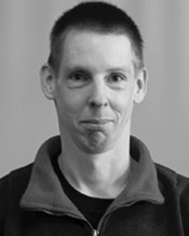
Roshy Pakdaman
Director at Gilead Sciences
Gilead Science, Inc.
333 Lakeside Drive
Foster City, CA
333 Lakeside Drive
Foster City, CA
LINKS
https://www.researchgate.net/profile/Rowchanak_Pakdaman/info
https://twitter.com/parissfo
https://www.facebook.com/roshy.pakdaman
https://www.linkedin.com/in/roshy-pakdaman-80b3248

Summary
Dr. Roshy Pakdaman is a Director in the Formulation and Process Development Department of Gilead Sciences. She has received her PH.D. in Physical Chemistry (1997) from University of Paris 7 (Dennis Diderot). In 1998 she joined Dr N.D. Chasteen’s group at the University of New Hampshire for a Postdoctoral Fellowship. In 1999, Dr Pakdaman became a Chemistry Associate Professor at the University of Paris 7 (Dennis Diderot, 1999-2002). Dr Pakdaman was a visiting scholar in J. Bartons’ group at Caltech University (20001-2002). In 2002 Dr Pakdaman joined the Formulation and Process Development Department of Gilead Sciences as a Research Scientist. She is responsible for lead optimization, preformulation, form selection, formulation development, process optimization, scale-up and process validation of a series of new oral clinical drug candidates.
Specialties: Lead Optimization, CMO management, Salt and Form Selection, Formulation and Process Development, Solid Dispersion, Spray Drying, Process Optimization, Scale-up and Validation
Specialties: Lead Optimization, CMO management, Salt and Form Selection, Formulation and Process Development, Solid Dispersion, Spray Drying, Process Optimization, Scale-up and Validation

Experience

Director
Gilead Sciences
Senior Scientist II
Gilead Sciences
Manage a team of 10 people
In charge of formulation and process development, process optimization and DOE, tech transfer, scale up and validation of solid dispersions and final drug products.
Formulation lead of several late stage drug products.
Formulation lead of Harvoni.
Regularly authored sections of CMC regulatory filings within IND, IMPD, CTD, NDA, JNDA and EMEA.
In charge of formulation and process development, process optimization and DOE, tech transfer, scale up and validation of solid dispersions and final drug products.
Formulation lead of several late stage drug products.
Formulation lead of Harvoni.
Regularly authored sections of CMC regulatory filings within IND, IMPD, CTD, NDA, JNDA and EMEA.
Senior Scientist I, Formulation and Process Development
Gilead Sciences
• Manage external contracts including manufacture of clinical supplies, preformulation and formulation development studies
• Efficiently worked as a CMC sub-team lead with multi-disciplinary functions (Clinical, Regulatory, Quality Assurance, Toxicology, Metabolism, Process Chemistry, Analytical Chemistry and Process Control) to meet project goals and timelines
• Regularly authored sections of CMC regulatory filings within IND, IMPD, CTD, scientific reports, manufacturing protocols and master batch records.
• Regularly authored, reviewed Quality Investigation Reports as well as Deviation Reports
• Responsible for formulation, process development, scale-up, clinical manufacturing and technology transfer of clinical drug products including tablets, powder in capsules, liquid filled capsules and oral solutions
• Lead the development of prototype amorphous solid dispersion systems produced by vacuum mixer homogenizer, hot melt extrusion and spray drying
• Experience with a variety of pharmaceutical manufacturing processes including particle sizing, powder mixing, high shear wet granulation, roller compaction, compression, pan coating, fluid bed drying, hot melt extrusion, Koruma homogenizing dispersing mixer, Olsa vacuum homogenizer mixer, encapsulation, capsule banding, capsule sealing and tray drying
• Experience with a variety of analytical instruments including DVS, DSC, TGA, HPLC, UPLC, LC-MS, Malvern, Hot stage microscopy, XRPD and GLpKa
• Efficiently worked as a CMC sub-team lead with multi-disciplinary functions (Clinical, Regulatory, Quality Assurance, Toxicology, Metabolism, Process Chemistry, Analytical Chemistry and Process Control) to meet project goals and timelines
• Regularly authored sections of CMC regulatory filings within IND, IMPD, CTD, scientific reports, manufacturing protocols and master batch records.
• Regularly authored, reviewed Quality Investigation Reports as well as Deviation Reports
• Responsible for formulation, process development, scale-up, clinical manufacturing and technology transfer of clinical drug products including tablets, powder in capsules, liquid filled capsules and oral solutions
• Lead the development of prototype amorphous solid dispersion systems produced by vacuum mixer homogenizer, hot melt extrusion and spray drying
• Experience with a variety of pharmaceutical manufacturing processes including particle sizing, powder mixing, high shear wet granulation, roller compaction, compression, pan coating, fluid bed drying, hot melt extrusion, Koruma homogenizing dispersing mixer, Olsa vacuum homogenizer mixer, encapsulation, capsule banding, capsule sealing and tray drying
• Experience with a variety of analytical instruments including DVS, DSC, TGA, HPLC, UPLC, LC-MS, Malvern, Hot stage microscopy, XRPD and GLpKa
Research Scientist II, Formulation & Process Development
Gilead Sciences
Research Scientist II, Formulation & Process Development 2004 – 2008
Research Scientist I, Formulation & Process Development
Gilead Sciences
Drug discovery support
Formulation and Process Development of immediate release solid dosage forms
Preformulation, salt selection, long term toxiclogy formulation development (Sub-cutaneous, Intra-venous, Oral), Solid-state and slolution-state stability of NCEs using LC-MS
Formulation and Process Development of immediate release solid dosage forms
Preformulation, salt selection, long term toxiclogy formulation development (Sub-cutaneous, Intra-venous, Oral), Solid-state and slolution-state stability of NCEs using LC-MS

Visiting Researcher
Caltech
Electron transfer study between DNA and base excision repair enzymes, which repair DNA mismatches. This study involves Flash quenching EPR, automated oligonucleotides and DNA synthesis and purification, bacteria cell culture, enzymes, HPLC, ES-MS, CD, UV-Vis. spectroscopy, Ion exchange / silica gel chromatography, synthesis of DNA intercalator such as Ru (II) complexes.

Associate Professor and ATER, Chemistry Department
Université Denis Diderot (Paris VII)
• Extraction and purification of human placental serum transferrin receptor. Biophysical and analytical study of the interaction between human serum transferrin (HST) and its specific receptor. This study involves standard chromatography procedures (I.E.C., Affinity gel chromatography, gel filtration), fast kinetics (stopped-flow), and fluorescence spectroscopy.
• Anaerobic study of bicarbonate uptake by lactoferrins.
• Established the mechanism of iron uptake by different species of lactoferrins (human, sheep, goat). All the kinetic and thermodynamic rate constants have been calculated, for each process.
• Anaerobic study of bicarbonate uptake by lactoferrins.
• Established the mechanism of iron uptake by different species of lactoferrins (human, sheep, goat). All the kinetic and thermodynamic rate constants have been calculated, for each process.

Postdoctoral Fellowship
University of New Hampshire
1998 - 1999
• Purification and characterization of recombinant and natural proteins.
• X-band EPR study of the binding site of mutant human serum transferrins.
• Established for the first time a detailed mechanism of iron storage process by ferritins by using stopped-flow, diode array and oxygen electrode.
• Purification and characterization of recombinant and natural proteins.
• X-band EPR study of the binding site of mutant human serum transferrins.
• Established for the first time a detailed mechanism of iron storage process by ferritins by using stopped-flow, diode array and oxygen electrode.
Courses
Université Paris Diderot
- Physical chemistry
Independent Coursework
- Technical writing
Education


 .
.
SAVING LIVES
The Gilead team responsible for Harvoni: Front row, from left: John Link, Chris Yang, Rowchanak Pakdaman, Bob Scott, and Benjamin Graetz. Back row, from left: Erik Mogalian and Bruce Ross. Not pictured: Michael Sofia.
Credit: Gilead Sciences
Gilead’s Harvoni is a combination of two antiviral agents, sofosbuvir and ledipasvir. “In hepatitis C, the virus mutates so rapidly that to overcome resistance, we use a combination of drugs, and each one pulls their own weight in the process,” says John Link, who discovered ledipasvir.
Link says that the amount of interdisciplinary collaboration on the drug was unprecedented for the company. “Once ledipasvir was discovered, the process chemists were right there with us understanding the kinds of things we were doing, and medicinal chemists and process chemists worked on making material to scale for preclinical studies,” he says. “We all realized this was our moment to make a difference for patients with hepatitis C.”
Harvoni is the first once-a-day pill for treatment of chronic hepatitis C, and it has a cure rate in the U.S. of 94-99%. The drug is an alternative to injected interferon treatment, which has been associated with significant side effects.
“The high cure rates that we saw in our clinical trials are really amazing,” Link says. “Before we had these compounds, I had only hoped that we could equal something like interferon-type regimens in cure rates, without all the horrible side effects. To dramatically exceed them is important for patients.”
Harvoni patients can attest to the drug’s effectiveness. Mark Melancon, who had contracted hepatitis C 25 years ago, says that after taking Harvoni, he now has no trace of the virus in his body, and his liver is beginning to repair itself. “Four weeks into it, and the virus was gone. Not detectable,” he says. “To have this virus hanging over my head for 25 years and then it was just gone, I can’t explain the feeling. The people who worked hard on this medication, they need to know that I appreciate it.”

///////////